Accident Towing Phoenix AZ | 24/7 Recovery & Storage
24/7 Accident Recovery • Phoenix Metro
Accident Towing & Recovery in Phoenix, AZ
Been in an accident? Stay safe and let us handle the rest. Freeway Towing & Storage provides 24/7 accident recovery and towing. We work with all insurance companies and can tow your vehicle to any body shop, dealership, or your home.
- Average response time in Phoenix: 30 minutes or less
- We do not charge after-hours or weekend surcharges for standard light-duty towing in Phoenix
- Professional drivers with proper equipment for your vehicle type
- Family-owned Phoenix towing company you can trust
Fast Response When It Matters Most
Accident scenes are chaotic and dangerous. You need a tow truck fast to clear the road and get you to safety. We use TowBook dispatch to prioritize accident calls.
Freeway Towing & Storage uses TowBook dispatch to send the closest available truck using live GPS. Our dispatcher can text you a secure location link so you can share your exact pin with one tap, then assign the nearest truck and send you a live ETA link by text so you can see exactly where your tow truck is.
- Live GPS on every truck so we dispatch the closest unit to your location
- One-tap TowBook location link when you’re not sure of cross streets or exits
- Real-time ETA updates by text so you always know when help will arrive
- Traffic-aware routing that avoids major backups on I-10, I-17, SR-51, Loop 101, Loop 202, and Loop 303
- Pre- and post-tow photos to document your vehicle and reduce damage disputes
- Digital records for insurance and property managers when needed
- This is why many drivers call us the fastest towing company in Phoenix
Comprehensive Accident Recovery
We don’t just tow the car; we help manage the situation:
- Collision Recovery: Safe loading of damaged vehicles, even if wheels are locked or missing
- Off-Road Winching: Recovering vehicles that have gone into ditches, medians, or desert landscaping
- Scene Cleanup: Sweeping up glass, debris, and plastic parts to leave the road safe (as required by law)
- Secure Storage: If you don’t know where to take the car yet, we can store it in our secure yard until insurance decides
- Insurance Coordination: We work directly with AAA, AllState, GEICO, State Farm, Progressive, USAA, Liberty Mutual, Nationwide, Farmers, American Family, and most other major insurance carriers. We bill directly and provide detailed itemized invoices for adjuster reimbursement.
- Flexible Drop-Off: We can tow your vehicle to any body shop, dealership, or your home
For electric vehicle accidents — Tesla (including Cybertruck), Rivian, Ford F-150 Lightning, Lucid, and other EVs — our crews follow specialized damaged-EV protocols including NFPA-aligned stranded-energy awareness, dedicated outdoor quarantine storage, and direct coordination with Tesla Roadside Assistance. See our Electric Vehicle Towing service for full details.
Tell our dispatcher where you’d like the vehicle to go—home, repair shop, dealership, or body shop—and we’ll handle the rest.
Accident Recovery Equipment We Use
Accident scenes require more than a standard tow truck. Vehicles with locked wheels, missing wheels, severe suspension damage, or rollovers cannot be loaded with conventional equipment. Every Freeway Towing & Storage truck dispatched to an accident scene carries the following:
Heavy-Duty Winches
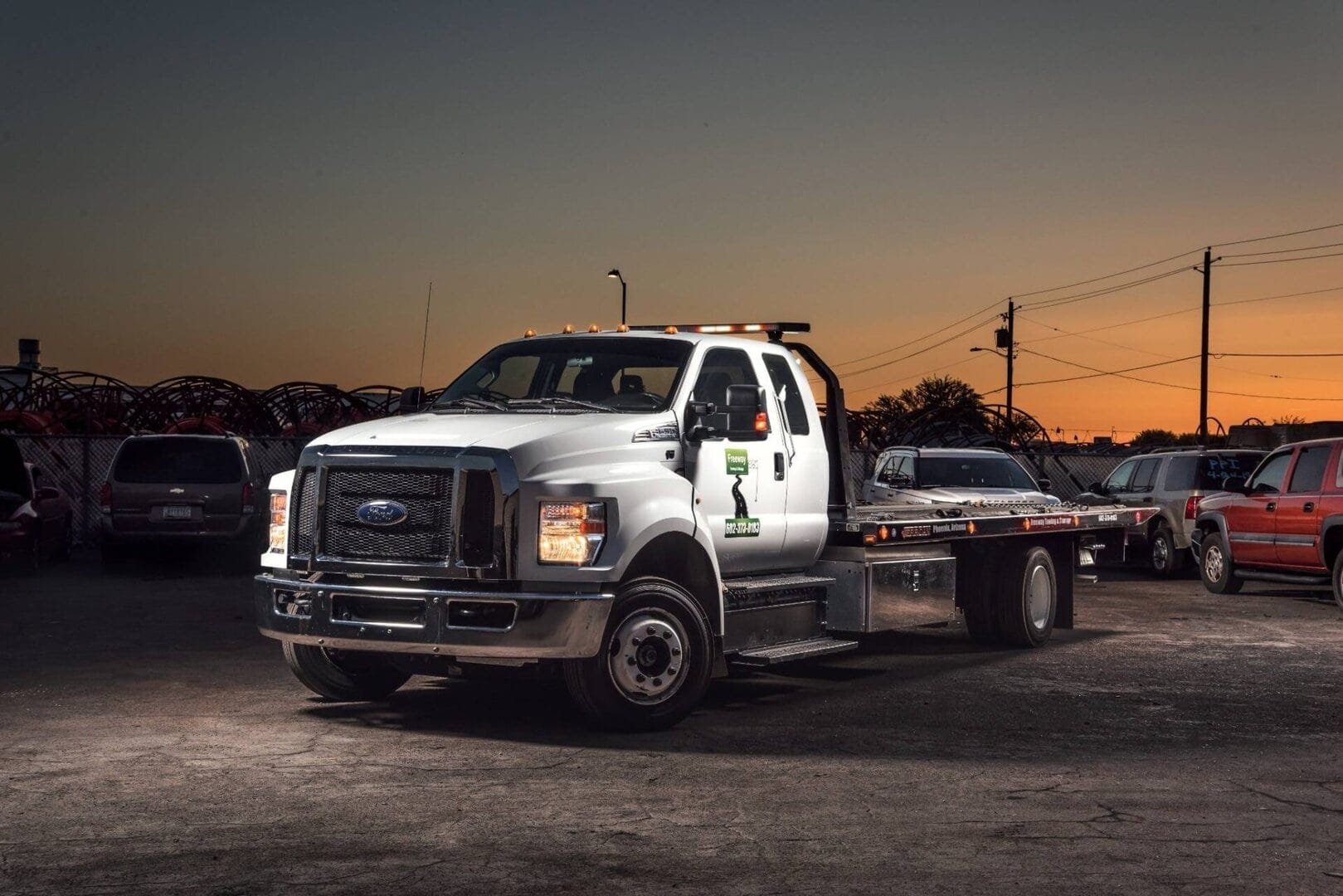
Every flatbed in our fleet is equipped with high-capacity electric winches rated for full vehicle weight. This allows us to drag and load vehicles even when wheels are locked from collision damage, suspension is destroyed, or the vehicle has come to rest in a position that prevents normal loading.
Vehicle Skates and Go Jacks
Vehicle skates slide under wheels that won’t roll due to collision damage, brake lockup, or missing tires. Go jacks lift a corner of the vehicle to clear obstacles and reposition for loading. These tools mean we can recover almost any wheeled vehicle regardless of post-collision condition.
Tow Dollies
For vehicles where the drivetrain can be lifted but the rear wheels need to roll, we carry tow dollies as a backup to full flatbed transport.
Recovery Air Bags and Cribbing
For rollover and flipped-vehicle recovery, our crews use recovery air bags and wooden cribbing to safely right vehicles back onto their wheels before loading. This prevents secondary damage during recovery.
Scene Sweeping Equipment
Arizona law requires accident scenes to be cleared of debris before the road is returned to traffic. Every truck carries brooms, dustpans, and absorbent material for glass, plastic parts, and fluid cleanup.
TowBook Photo Documentation
Every accident tow is documented with 15-40 time-stamped, geo-tagged photos captured on intake and delivery. This protects you against false damage claims, supports insurance documentation, and creates a clear chain of custody for total-loss assessments.
GPS Live Tracking on Every Truck
TowBook GPS dispatch lets us send the closest available unit to your scene, with real-time ETA updates by text and a one-tap location pin if you’re not sure of cross streets or exit numbers.
Types of Accidents We Recover
Not every accident is a fender-bender. Our crews are trained and equipped for the full range of collision and recovery scenarios that happen across the Phoenix metro.
Multi-Vehicle Freeway Collisions
The most common type of serious accident we respond to. We work the major Phoenix freeway corridors including I-10, I-17, Loop 101, Loop 202 (South Mountain and Red Mountain), SR-51 (Piestewa), US-60 (Superstition), and Loop 303. Our dispatchers monitor traffic-aware routing to reach scenes quickly even during rush hour or major incident closures.
Single-Vehicle Off-Road and Ditch Recovery
Phoenix’s desert landscaping, drainage ditches, medians, and embankments are common rest stops for vehicles that lose control. Heavy-duty winching and proper anchor points let us recover vehicles from ditches, washes, retention basins, and even off-pavement desert without damaging the vehicle further.
Rollover and Flip Recovery
Rolled or flipped vehicles need to be carefully stabilized, righted using recovery air bags or cribbing, and then loaded onto a flatbed. Wheel-lift or hook-and-chain methods are not safe for rolled vehicles. We dispatch flatbeds with the recovery equipment needed for these scenes.
Parking Lot and Low-Speed Collisions
Shopping centers, parking garages, apartment complex lots, and downtown surface lots — low-speed but still requiring proper recovery and insurance documentation. We coordinate with property managers, HOA boards, and on-site security when needed.
Hit-and-Run Scenes
If you’re the victim of a hit-and-run, we coordinate with the police report process and provide detailed scene documentation through TowBook photos. This documentation can support your insurance claim even when the at-fault driver is unknown.
DUI and Late-Night Single-Vehicle Crashes
Late-night crashes on Loop 101, Loop 202, and the I-10 stretches through Tempe and Chandler are common. Our 24/7 dispatch means there’s no after-hours surcharge and no wait for morning operating hours. Standard rates apply at 3 AM the same as 3 PM.
Construction Zone and Highway Work Area Crashes
Active work zones require extra coordination with ADOT, contractor flaggers, and DPS. Our drivers are trained on work-zone scene safety and proper staging in narrow shoulders or coned-off areas.
Heavy-Duty Vehicle Accidents
For semi-truck, RV, motorhome, box truck, or commercial fleet vehicle accidents, see our heavy-duty recovery service. These scenes require larger wreckers, different rigging, and specialized recovery protocols.
How Much Is Accident Towing and Recovery in Phoenix?
After accidents, there are many more factors involved in tow pricing compared to standard breakdown towing. While standard towing in Phoenix typically costs $95 for the hook and $6 per loaded mile, accident recovery pricing can vary significantly based on the severity and circumstances of the accident.
Major Factors That Affect Accident Towing Pricing:
- Vehicle Damage: How much damage is done to the vehicle
- Tire Condition: Do all 4 tires still roll, or are wheels missing/damaged?
- Collision Type: Did the vehicle run into a ditch, light pole, building, or curb?
- Rollover/Flip: Did the vehicle flip or roll over?
- Cleanup Required: How much debris cleanup is involved at the scene?
- Off-Road Recovery: Does the vehicle need to be recovered from a ditch, median, or off-road location?
This is why being as descriptive as possible to the dispatcher is crucial for an accurate quote. The more details you can provide about the accident scene and vehicle condition, the more accurate your price estimate will be.
We have the capability for customers to send photos of the scene, and we can give an exact price on the loading based on what we see. The mileage towed is still calculated the same way ($6 per loaded mile), but the hook fee may vary based on the complexity of the recovery.
Important: Not all accident towing will raise the price off the hook fee. If the vehicle can roll normally and doesn’t require special recovery equipment or extensive cleanup, the standard $95 hook fee applies. It’s best to confirm with dispatch when you call to get the most accurate pricing for your specific situation.
👉 Use our Tow Price Calculator for a base estimate, or call (602) 377-0036 to speak with a dispatcher who can give you an exact quote based on your accident details. You can also send photos of the scene for a more accurate assessment.
What to Do at the Accident Scene
Stay calm and work through these steps in order. Most of this can be done from inside the vehicle if traffic conditions make it unsafe to exit.
- Get to safety. If your vehicle is drivable and you’re not blocking traffic, move it onto the shoulder, into a parking lot, or onto a side street. Turn on hazard lights and set the parking brake. If the vehicle is disabled in a live lane and it’s unsafe to exit, stay buckled with hazards on until help arrives.
- Check for injuries. Check yourself, your passengers, and the occupants of other vehicles if you can do so safely. Call 911 immediately if anyone is hurt.
- Call the police. Arizona requires a police report for collisions involving injury, death, or significant property damage. Even for minor accidents, a police report protects you during the insurance process.
- Exchange information with other drivers. Get name, phone number, insurance company, policy number, driver’s license number, license plate, and vehicle make/model/color from every other driver involved.
- Photograph the scene thoroughly. Damage on all vehicles, license plates, the accident location with cross streets visible, traffic signals and signs, road conditions, and the other driver’s documents. The more photos, the stronger your insurance position.
- Note witnesses. If anyone saw the accident, ask for their name and phone number. Witness statements can be decisive when fault is disputed.
- Call Freeway Towing & Storage at (602) 377-0036. Text dispatch a location pin and photos of vehicle damage and scene conditions. We can give you an exact quote based on photos and dispatch the closest truck. Average response time in Phoenix is 30 minutes or less.
- Notify your insurance company. Give them the towing company name (Freeway Towing & Storage), the destination of your vehicle (body shop, dealership, home, or our secure storage yard), and the accident location. This starts your claim and keeps the vehicle’s location documented.
Safety on Phoenix Freeways
If your vehicle is disabled on a Phoenix freeway shoulder, your safety comes first. Steer as far onto the shoulder as possible, put the vehicle in park, set the parking brake, and turn on hazard lights. Avoid standing next to traffic or in live lanes. If traffic is heavy or visibility is low, it is often safer to stay buckled inside the vehicle with hazard lights on until help arrives.
You cannot leave a vehicle on the shoulder for long. DPS or local police may have it towed and impounded in just a few hours. If you must leave temporarily for safety, leave a note on the dash with the time and your phone number, and call the non-emergency line to let them know a tow truck from Freeway Towing & Storage is on the way.
Call now for towing in Phoenix: (602) 377-0036.
Your Rights After an Accident in Phoenix
After being in an accident in Phoenix, there is important information you should know. You have the right to contact a private towing company or non-contracted company to tow your vehicle after an accident.
However, it’s important to understand the difference between a private towing company and a government-contracted towing company, as this can affect your costs, timeline, and options.
Private vs. Government-Contracted Towing Companies
Different cities, counties, and state municipalities have towing contracts with specific towing companies throughout Arizona. These contracts cover:
- DPS (Department of Public Safety) – State highway towing contracts
- City of Phoenix – Municipal towing contracts for city streets
- County Sheriff Offices – County-level towing contracts
- Other Cities – Mesa, Tempe, Glendale, and other municipalities have their own contracts
These contracts have set rates for towing and storage that are posted online and must also be displayed at the tow yard. Using a contracted company is not mandatory, but if you choose a private, non-contracted towing company, they must arrive on scene within 20 minutes.
Important: Public streets and highways need to be cleared of accidents quickly to not impede traffic flow. The decision often comes down to the discretion of the commanding officer on scene. Having a fast, DPS-certified towing company saved in your phone is crucial in the event of an accident.
What Happens When a Contracted Company Tows Your Vehicle
If a contracted company removes your vehicle from the accident scene, the officer will give you a Vehicle Removal Sheet that lists:
- Information about your vehicle
- The towing company that picked up your vehicle
- The location where your vehicle was taken
- The date and time of removal
Contracted towing rates are posted online and must also be posted at the tow yard that holds these contracts. These rates are typically set by the municipality and may differ from private towing company rates.
Requirements to Remove Your Vehicle from Impound
There are specific requirements to remove your car from impound lots, whether it’s a contracted or private facility. You will need:
- Proof of Ownership or Financial Interest: Title, current registration, or certified Motor Vehicle Record (MVR)
- Proof of Identification: Valid government-issued ID or passport
- Payment: Towing and storage fees (which may be covered by insurance – see below)
Make sure you have these documents ready before going to retrieve your vehicle to avoid delays.
Who Pays for Towing and Recovery After an Accident?
Generally, the at-fault driver’s insurance company is liable for towing and storage charges. However, the process can be more complex:
- If the at-fault driver’s insurance denies liability or deems there was no active insurance to cover those charges, your own insurance will cover those charges if you have full collision coverage
- The owner of the vehicle has a responsibility to contact any insurance companies involved (or your lawyer) to give the location of your vehicle
- Insurance companies need this information so they can either move vehicles from storage yards to body shops for estimates and repairs, or send field inspectors to do damage assessments at the tow yard
Total Loss Vehicles: What Happens Next?
If the insurance company deems your vehicle a total loss after a field inspector assesses the damage at the tow yard, they will:
- Offer you a payout for the value of the vehicle at the time of the accident
- Move the vehicle from the tow yard to an auction facility like IAA (Insurance Auto Auctions) or Copart Auto Auctions
- Sell your vehicle at auction to recoup as much money as they can
This process can seem confusing, and there are important things you should keep an eye on and stay on top of during the claims process.
⚠️ Important: Arizona’s 10-Day Abandoned Vehicle Rule
In Arizona, a towing company can file for an abandoned vehicle title if your car is left for more than 10 days.
After the vehicle is left for 10 days, towing companies can file an application for abandoned title. A notice is sent out to the last known registered owner and lien holders (if any). They receive the abandoned vehicle notice giving information about:
- Where your vehicle was towed
- What date it was towed in
- The process to reclaim your vehicle
This is why staying in contact with your insurance company and the towing company is critical – especially when liability disputes can take weeks or months to settle.
Mitigation of Losses: Understanding Your Responsibilities
Not all accidents have clear liability and can often take weeks or months to settle. During this time, insurance companies may send out a mitigation letter stating that as the owner of the vehicle, you have a duty and responsibility to mitigate losses.
What does “mitigation of losses” mean? In insurance terms, it means taking reasonable steps to minimize the financial impact of a claim. This includes preventing additional damage or expenses, such as excessive storage fees.
The problem: How are you supposed to mitigate liability of excessive storage fees if you have nowhere to store the wrecked vehicle? Most apartments and houses that belong to HOAs have strict rules against inoperable or wrecked vehicles being parked there – and they will tow them if they are left.
Insurance companies will tell you to tow it to a place that does not charge storage – but this is very rarely an option. If you tow it to a body shop, the body shop will charge storage to the insurance company if it’s deemed a total loss. Some shops will not charge storage if they do the vehicle repairs, but this isn’t always possible.
There can be a lot of pressure put on vehicle owners by insurance companies, many times threatening to take any “excess storage” out of their total loss or settlement offer.
Why Choose a Private Towing Company That Works With Insurance
This is where having a private, independent towing company that is willing to work with insurance companies comes in handy.
Freeway Towing & Storage takes pride in working with insurance companies to settle excessive storage bills. Many towing companies do not care and only have their best interest in mind. Unfortunately, insurance companies are also only caring about the company bottom line.
This is why keeping in direct contact, updating vehicle locations if moved, and working with a towing company that understands the insurance process can save you from having any money taken out of your settlement offer.
When you choose Freeway Towing & Storage for accident recovery, you’re choosing a company that will advocate for you throughout the insurance claims process, not just collect fees and move on.
Accident Towing & Recovery FAQs
Do I have to use the tow truck the police call?
In most cases, no. Unless you are blocking a major highway lane and police need it cleared instantly (rotation tow), you have the right to request your own tow company. Tell the officer you are calling Freeway Towing & Storage. Private towing companies must arrive within 20 minutes if you choose them over a contracted company.
Will insurance pay for the tow?
Generally, the at-fault driver’s insurance company is liable for towing and storage charges. If they deny liability or have no active coverage, your own insurance will cover those charges if you have full collision coverage. We bill you directly and provide a detailed invoice that you can submit to your adjuster for reimbursement.
Where should I have my car towed?
You can have it towed to your home, a body shop of your choice, or the dealership. If you aren’t sure yet, we can tow it to our secure storage yard for a few days while you coordinate with your insurance. It’s important to keep your insurance company updated on the vehicle’s location.
Can you tow a car that won’t roll?
Yes. Our flatbeds are equipped with powerful winches and skates/dollies to drag and load vehicles even with locked wheels, missing wheels, severe suspension damage, or vehicles that have flipped or rolled over. We can handle off-road recovery from ditches, medians, and other difficult locations.
How much does accident towing cost compared to regular towing?
Standard towing starts at $95 hook fee plus $6 per loaded mile. Accident towing pricing can vary based on vehicle damage, whether all tires roll, collision type (ditch, pole, building), rollover/flip, and cleanup required. Not all accidents raise the hook fee—if the vehicle can roll normally, standard pricing applies. We can give you an exact quote based on photos of the scene.
Can I send photos of the accident scene for a more accurate quote?
Yes. We have the capability for customers to send photos of the scene, and we can give an exact price on the loading based on what we see. The more descriptive you can be about the vehicle condition and accident circumstances, the more accurate your quote will be. Call (602) 377-0036 to speak with a dispatcher about sending photos.
What’s the difference between a private towing company and a government-contracted one?
Government-contracted towing companies have set rates posted online and at their yards, and are used by DPS, city police, and county sheriff offices. Private companies like Freeway Towing & Storage can work more flexibly with insurance companies to settle storage bills and advocate for you during the claims process. You have the right to choose either option.
What happens if my car is left at a tow yard for more than 10 days?
In Arizona, towing companies can file for an abandoned vehicle title if your car is left for more than 10 days. A notice is sent to the registered owner and lien holders. This is why it’s critical to stay in contact with your insurance company and the towing company, especially when liability disputes can take weeks or months to settle.
What does “mitigation of losses” mean and how does it affect my claim?
Mitigation of losses means taking reasonable steps to minimize financial impact, such as preventing excessive storage fees. Insurance companies may threaten to deduct “excess storage” from your settlement. The problem is you often can’t store a wrecked vehicle at home (HOA/apartment rules). This is why working with a towing company like Freeway Towing & Storage that works with insurance companies to settle storage bills is crucial.
How does Freeway Towing & Storage work with insurance companies differently?
We take pride in working with insurance companies to settle excessive storage bills, rather than only looking out for our own interests. We understand the insurance claims process and will advocate for you throughout. By keeping in direct contact, updating vehicle locations if moved, and working collaboratively with adjusters, we help ensure you don’t have money taken out of your settlement offer.
What equipment do you use for rollover or flipped vehicle recovery?
Our crews carry recovery air bags and wooden cribbing to safely right rolled and flipped vehicles before loading. Once stabilized, the vehicle is winched onto a flatbed for transport. Wheel-lift and hook-and-chain methods are not safe for rolled vehicles, so flatbed transport is the only correct option.
Can you recover a vehicle from a ditch or off-road location?
Yes. Single-vehicle off-road accidents into ditches, medians, drainage washes, and desert landscaping are common in the Phoenix area. Our flatbeds carry heavy-duty winches and the rigging needed to safely recover vehicles from off-pavement positions without additional damage.
Do you charge extra for accident towing at night, on weekends, or holidays?
No. Our standard accident towing rates apply 24 hours a day, 7 days a week, 365 days a year. There are no after-hours, weekend, or holiday surcharges. Standard light-duty pricing is $95 hook fee + $6 per loaded mile, with recovery surcharges applied only for situations requiring special equipment, scene cleanup, or off-road recovery.
Which insurance companies do you work with?
We work directly with AAA, AllState, GEICO, State Farm, Progressive, USAA, Liberty Mutual, Nationwide, Farmers, American Family, and most other major insurance carriers. We bill directly and provide detailed itemized invoices that you can submit to your adjuster for reimbursement. For complex claims involving liability disputes or excessive storage fees, we work with adjusters to settle bills collaboratively.
Related Towing Services in Phoenix
Need something other than accident towing & recovery? Freeway Towing & Storage also provides:
Need Accident Towing & Recovery in Phoenix Right Now?
Our drivers are on the road 24/7 and can usually reach you in 30 minutes or less. Call now and we’ll dispatch the closest truck to your location.
📞 Call (602) 377-0036 – 24/7 Accident Towing & Recovery